
By Pablo Alvarez
A sense of time…
Some wine collections are built around a celebrated estate, a prestigious appellation or a sequence of great vintages. Others reveal something more elusive: a sense of time.
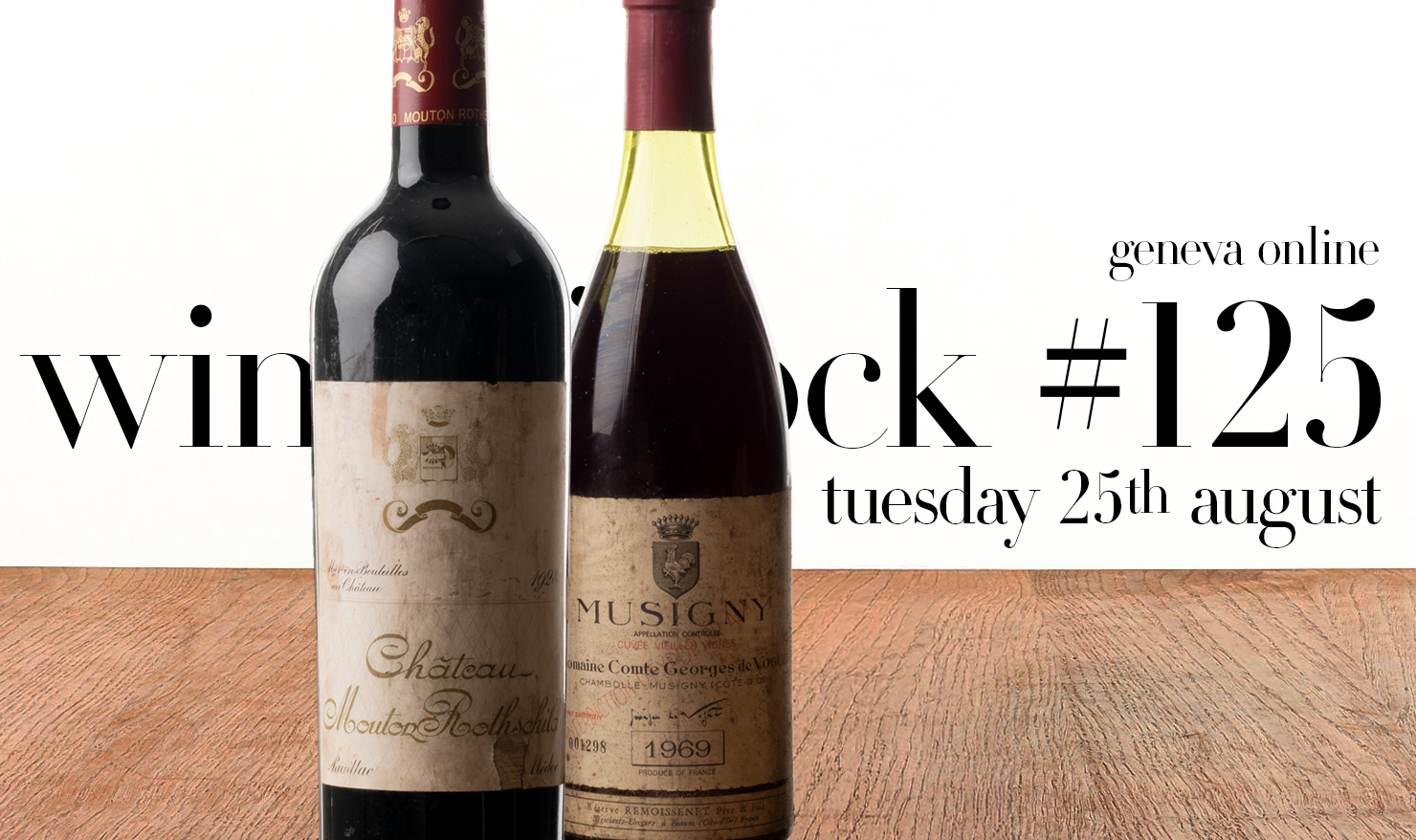
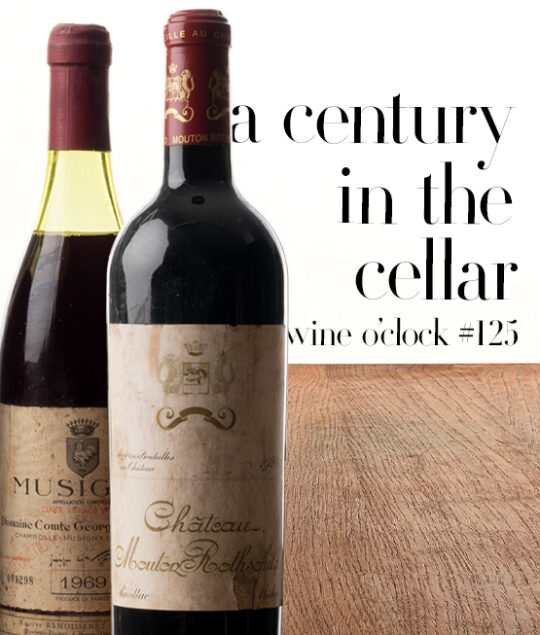
Our “wine o’clock” #125 belongs firmly to the latter category. Bringing together 149 lots from Burgundy and Bordeaux, the sale spans more than half a century, from 1916 to 1970. Rather than presenting a simple succession of rare bottles, the catalogue invites collectors on a chronological journey through two of France’s greatest wine regions.
It begins in Burgundy with a remarkable collection from Domaine Comte Georges de Vogüé before turning towards Bordeaux and a succession of legendary châteaux. Together, these wines form a panorama of the twentieth century: celebrated harvests and less familiar vintages, changing styles and enduring terroirs.
Each bottle has travelled through decades of history. Its label, capsule and level bear witness to a journey that can never be reproduced.
Burgundy—the singular voice of Comte Georges de Vogüé
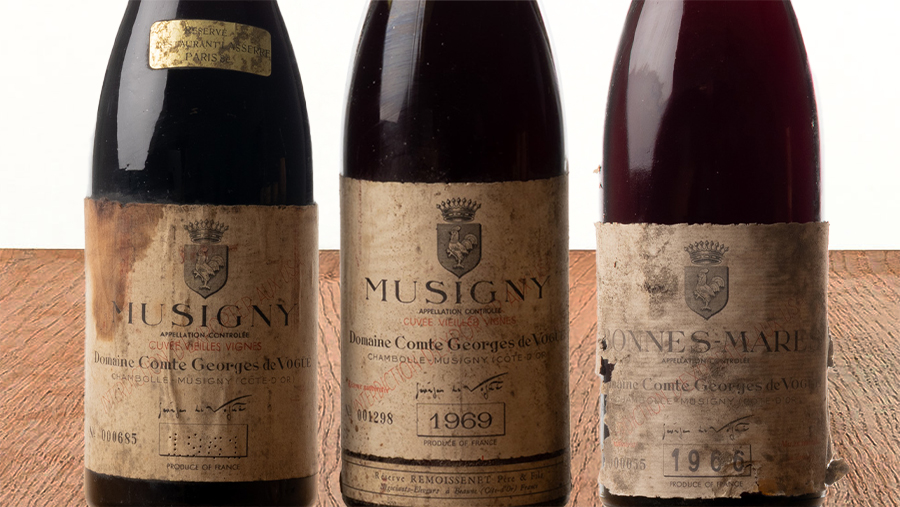
The opening chapter is devoted entirely to Domaine Comte Georges de Vogüé, represented by 19 lots. Few estates embody the historical depth and quiet authority of Chambolle-Musigny with such distinction.
The domaine is inseparable from the identity of the village and from some of its most revered vineyards. Musigny is renowned for its refinement, complexity and extraordinary persistence, while Bonnes-Mares generally offers a broader and more structured expression, without losing the finesse associated with Chambolle-Musigny.
Older Burgundy is exceptionally scarce. The region has always been defined by small parcels, limited production and highly fragmented ownership. As the decades pass, bottles are opened, disappear into private cellars or are lost through imperfect storage. The surviving examples become increasingly precious.
Among the highlights, Musigny Vieilles Vignes 1961 immediately commands attention. While 1961 is remembered as one of the twentieth century’s great European vintages, mature Burgundy from this year is now encountered far less frequently than its Bordeaux counterpart. After more than six decades of evolution, such a bottle offers the possibility of discovering the complex language of mature Pinot Noir.
Musigny Vieilles Vignes 1969 provides another important landmark. Highly regarded in Burgundy, the vintage produced wines combining freshness, structure and aromatic precision. The best examples continue to show a remarkable balance between delicacy and persistence.
Bonnes-Mares 1966 introduces a contrasting facet of the domaine. More muscular and reserved in its youth, Bonnes-Mares can acquire remarkable depth and harmony after decades in bottle.
Together, these wines invite comparison between vineyard, vintage and evolution within a single great domaine. Placed side by side, they form a dialogue between Musigny and Bonnes-Mares, between different years and between the wine originally created and the wine it has become.
A journey through Bordeaux
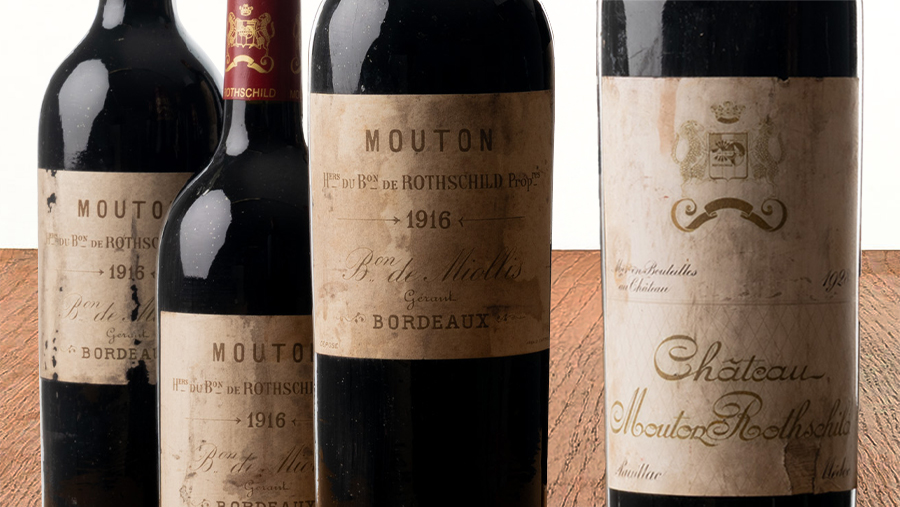
The second chapter turns towards Bordeaux, with names that have shaped the international history of fine wine: Château Mouton Rothschild, Château Lafite Rothschild, Château Latour, Château Margaux, Château Haut-Brion, Château La Mission Haut-Brion, Château d’Yquem, Château Ausone and Petrus.
The journey begins with Château Mouton Rothschild 1916. Produced during the First World War, this bottle belongs to a world profoundly different from our own. Its survival is exceptional, not only because of its age, but because it has endured more than a century of historical and social change.
A bottle from 1916 should not be approached solely through conventional expectations of performance. It is an artefact of wine history: fragile, moving and extraordinarily rare.
Mouton Rothschild appears again in 1928, notably in a lot of six bottles. Whereas many early twentieth-century wines now emerge as solitary examples, a group of six presents collectors with a rare opportunity to experience natural bottle variation, preserve part of the lot or share it across several occasions.
The 1928 vintage remains one of the great references of the interwar period, remembered for wines of formidable structure and longevity.
From the 1930s to the post-war renaissance
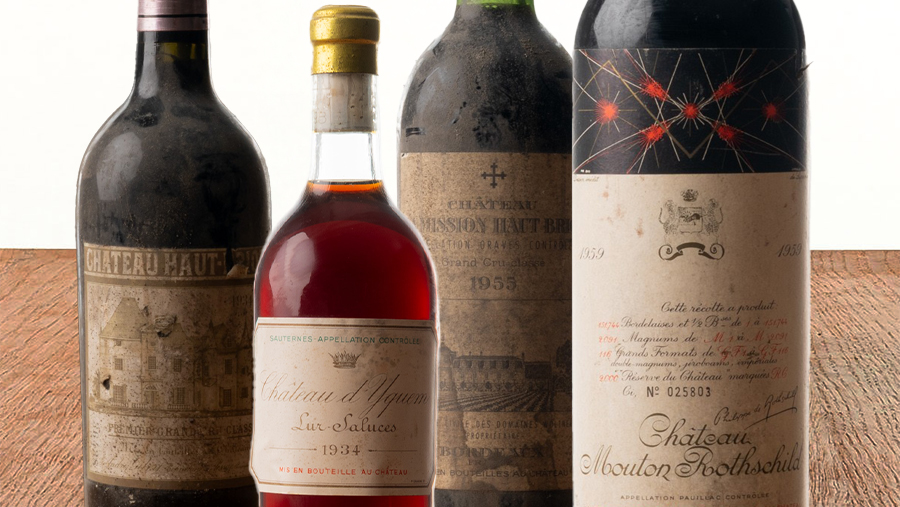
The chronological structure of the catalogue also encourages collectors to reconsider less obvious periods. Wine history is often reduced to a short list of universally acclaimed vintages, but an old wine can never be understood through a vintage chart alone. Producer, terroir, storage and the individuality of each bottle remain decisive.
The year 1934 is represented by several important estates, including Château Haut-Brion and Château d’Yquem.
Haut-Brion holds a unique position among the First Growths. Its wines are distinguished by their aromatic complexity, characteristic smoky nuances and ability to acquire extraordinary depth with age. The Haut-Brion 1934 is offered in several configurations, allowing collectors to choose between a single historical bottle or a group of bottles from the same vintage.
Château d’Yquem 1934 brings an entirely different rhythm to the collection. Great Sauternes evolves according to its own timescale. Concentration, acidity and noble rot can allow Yquem to develop over extraordinary periods, gradually revealing notes of beeswax, dried citrus, saffron and spice.
The 1950s then mark a period of renewal for Bordeaux. Château La Mission Haut-Brion 1955 is among the sale’s compelling post-war highlights. Long admired by knowledgeable collectors, La Mission has repeatedly produced wines capable of standing alongside the most celebrated classified growths.
The 1955 vintage is valued for its harmony and balance rather than sheer power—qualities that have allowed its finest wines to evolve gracefully.
Château Mouton Rothschild 1959 offers a richer and more opulent expression of Bordeaux. For many collectors, mature wines from the 1950s occupy an ideal intersection: sufficiently evolved to display the transformation brought by bottle ageing, yet still capable, in the finest examples, of remarkable presence and vitality.
The 1960s and the final landmark
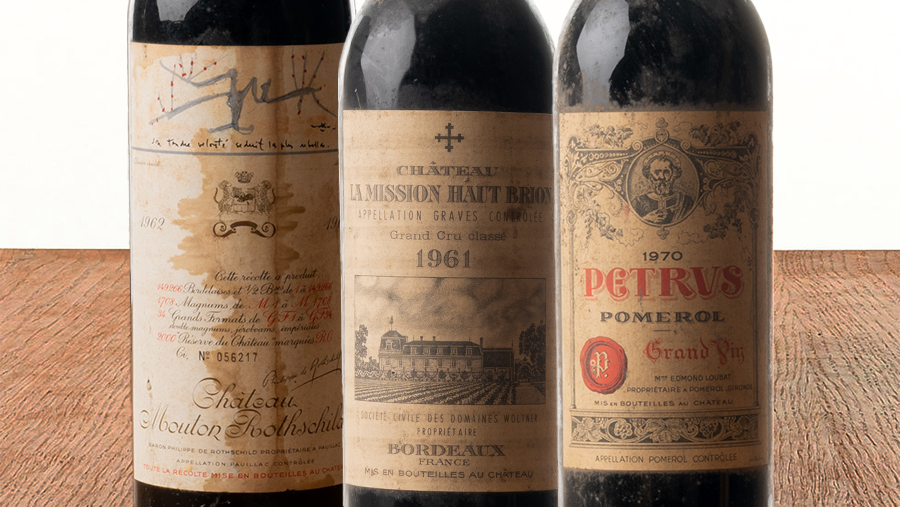
The 1960s bring the Burgundy and Bordeaux narratives into closer conversation. It is the decade of Musigny Vieilles Vignes 1961 and 1969, Bonnes-Mares 1966 and several significant Bordeaux bottlings.
Mouton Rothschild 1962 is offered in both bottles and magnums. Large formats have always held a special place in wine culture, not merely for their visual grandeur but also for their slower evolution. The lower proportion of oxygen to wine can enable a magnum to retain a distinctive balance between maturity and freshness.
The vintage itself has often lived in the shadow of the monumental 1961. Yet this forms part of its appeal. The best 1962s can display classical proportions, elegance and freshness without the premium attached to one of the century’s most famous harvests.
The journey concludes in 1970 with Petrus, bringing the catalogue to Pomerol and one of the world’s most coveted wines. Petrus derives its identity not from an imposing château or a traditional classification, but from its distinctive clay soils and its profound expression of Merlot.
As the final chronological point of the sale, Petrus 1970 provides a fitting conclusion to a narrative that begins with Mouton Rothschild during the First World War and travels across 54 years of wine history.
Collecting time
The significance of “wine o’clock” N°125 lies not only in the rarity of its individual bottles, but also in the relationships between them.
A Burgundy collector may explore the different expressions of Domaine Comte Georges de Vogüé. A Bordeaux enthusiast may follow Mouton Rothschild across several decades. Others may compare Haut-Brion and La Mission Haut-Brion, or contrast mature red Bordeaux with the extraordinary longevity of Château d’Yquem.
There is also an inevitable sense of urgency. Vineyards can produce another vintage, but they cannot recreate 1916, 1928, 1934, 1955, 1961 or 1969. Every bottle opened reduces the number remaining, making each well-preserved example that returns to the market an event in itself.
From the finesse of Musigny Vieilles Vignes to the authority of Bonnes-Mares; from Mouton Rothschild 1916 to mature Yquem, La Mission Haut-Brion and Petrus 1970, this catalogue presents wine as a living archive.
To collect these bottles is not simply to possess them. It is to preserve, interpret and eventually share them—to recognise that the most precious element in an old bottle may not be its reputation or rarity, but the time it contains.
“Wine o’clock” N° 125 comprises 149 lots of Burgundy and Bordeaux, spanning the vintages 1916 to 1970. The complete catalogue and bidding information are available below.
the sale